What Is Haga in Gothenburg Known for? Sweden's Wooden Old Quarter Explained
Haga is Gothenburg's old working-class quarter, known for its wooden landshövdingehus houses, the car-free Haga Nygata, oversized cinnamon buns and the Skansen Kronan viewpoint.
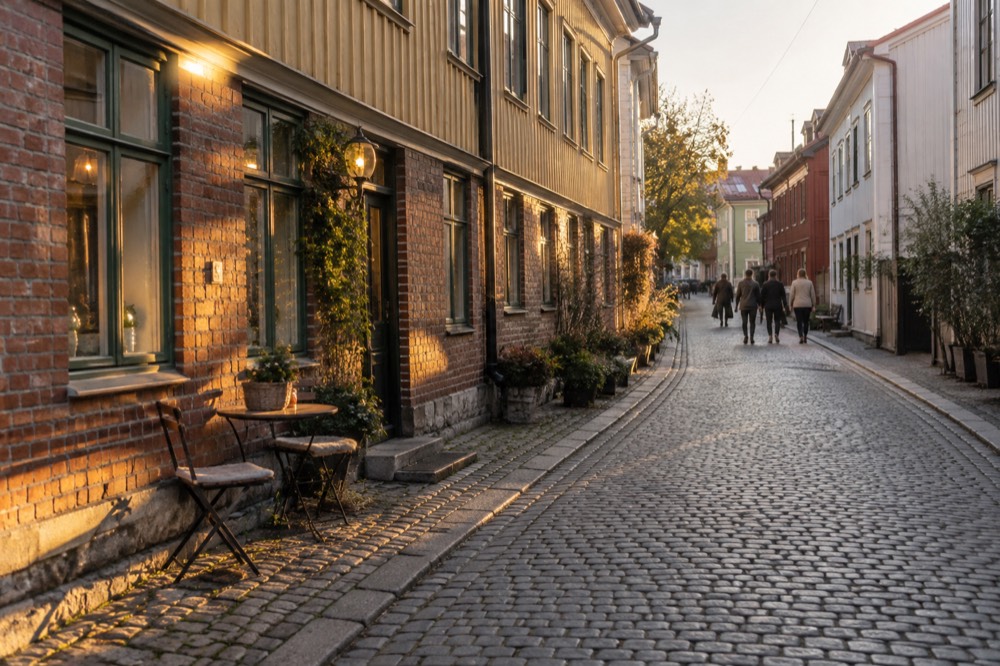
Haga sits immediately north of Gothenburg's moat, and it is the one district in the city where the past still looks roughly the way it looked. Low wooden houses stand shoulder to shoulder along cobbled lanes, a pedestrian street runs through the middle of it, and an old fort crowns the ridge above. Most of what people associate with old Gothenburg, the painted timber, the small cafés, the hills, is concentrated into these few blocks. This page explains what Haga actually is, what it is famous for, and how it fits into a visit to Sweden's second city.
What Is Haga in Gothenburg, Sweden?
Haga is Gothenburg's oldest surviving working-class quarter, laid out just outside the city moat in the city's early decades, and it is known today for its preserved wooden and landshövdingehus buildings, its car-free main street Haga Nygata, its café and second-hand culture, and the hilltop fort Skansen Kronan above it. It was saved from demolition by a preservation movement and is now one of the most visited districts in Västra Götaland.
The name goes back to the city's earliest years. When Dutch engineers laid out Gothenburg inside its moat, the land beyond the northern rampart was used for grazing and gardens, and a settlement grew there for the people who could not afford to live inside the walls: workers, sailors and their families. That origin as a poor suburb outside the fortifications is why the district feels so different from the stone blocks of the inner city. Space was tight, plots were small, and the houses were built low and cheap in timber. The city's own planning documents treat the quarter as a distinct historic environment, and the municipal property company Higab, which manages several of the city's landmark buildings, lists its historic holdings by district, which underlines how formally the city now protects this stock.
The building type that defines the district is the landshövdingehus, a Gothenburg speciality: a lower storey in stone or brick with two or three storeys of wood above it. The stone ground floor was a fire rule, the wooden upper floors were cheap to build, and the result is a house shape you find almost nowhere else in Sweden at this scale. Whole streets of them survived in Haga because the district was poor enough to be ignored by developers for decades, then poor enough to be threatened with demolition, then finally recognised as the largest coherent stretch of old wooden Gothenburg left standing.
That demolition threat is the reason the district exists as you see it. In the postwar decades large parts of it were condemned, and some blocks were torn down before opinion turned. The preservation movement that grew up around Haga is now considered a turning point in Swedish urban conservation, and the renovated quarter became the template for how Gothenburg treats its older neighbourhoods. The district you walk through today is therefore not a museum piece that survived by accident: it is a deliberately saved landscape, restored with the wooden façades, cobblestones and small shopfronts kept in place.
The restoration also explains the retail mix you find now. Because the buildings were saved rather than redeveloped, the ground-floor units stayed small, and small units suit small businesses. That is why the quarter is full of independent shops rather than chain stores, and why the street-level texture feels different from the stone commercial blocks around Avenyn. The preservation did not just save architecture; it saved a scale of commerce that no longer gets built.
For context on the city around it, see what Gothenburg is known for. The quarter also plays a part in the city's nickname story, covered in why Gothenburg is called Little London, because the wooden hills and the maritime workers who lived here are part of how the city's character formed.
What Can You Actually See and Do in Haga?
The district's core sights are Haga Nygata, the stepped pedestrian street lined with cafés and independent shops; the surrounding cobbled lanes of landshövdingehus houses; Skansen Kronan, the hilltop fort with the classic panorama over the city's rooftops; and a dense strip of bakeries, second-hand shops and coffee houses that make the quarter Gothenburg's standard fika stop. All of it is walkable in a single short visit.
Haga Nygata is the spine of the visit. It runs gently downhill through the quarter, closed to traffic, with low wooden buildings on both sides and a paving pattern that follows the slope in broad steps. The shop mix is small-scale by design: ceramics, books, vintage clothing, chocolate, and above all coffee. This is where the district's most famous export lives, the oversized cinnamon bun. The bakers here compete on size, and the giant kanelbulle served with coffee is the single most photographed food item in the neighbourhood. For the culture behind that habit, read what fika means in Sweden.
The street itself rewards slow walking. Because it steps down the hillside, the view changes constantly: house fronts close in at the top, and the city opens up toward the bottom where the quarter meets the moat and the modern centre. The cobblestones are genuine, not set dressing, and they are part of what the restoration fought to keep. Several of the façades carry painted signs and old shop lettering that were retained during renovation, which gives the street a layered look rather than a polished one. Visitors who walk only the main street see the famous version of the quarter; visitors who turn off it see the lived-in one.
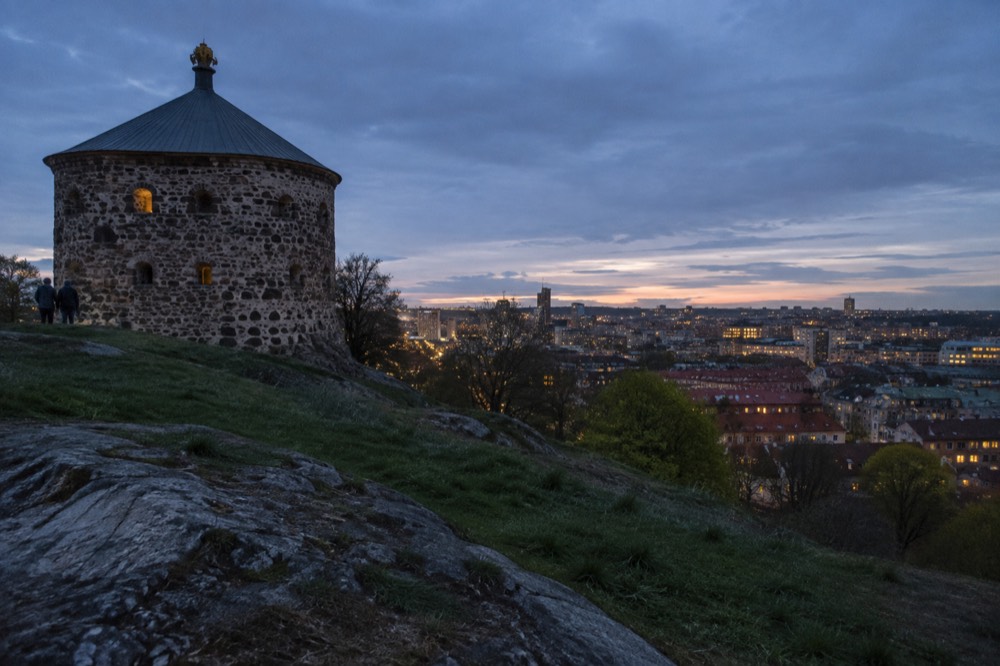
Above the quarter rises Skansen Kronan, one of the two hilltop forts built to guard early Gothenburg. The climb up through the wooden streets is short and steep, and the platform at the top gives the view most people come to Haga for: red tiled roofs, church towers, the Göta älv, and the harbour cranes further out. The fort's twin, Skansen Lejon, stands across the city on the other side of the river. Our Skansen Kronan and Gothenburg's hilltop forts page covers the forts in detail, and Haga, Gothenburg's wooden old quarter is the full neighbourhood guide.
A rough shape for a visit:
| Stop | What it is | Time needed |
|---|---|---|
| Haga Nygata | Pedestrian street, cafés, small shops | About an hour |
| Side lanes off the main street | Cobblestones and timber houses | Half an hour or so |
| Café fika stop | Cinnamon bun and coffee | As long as the coffee lasts |
| Skansen Kronan | Hilltop fort and city viewpoint | Under an hour |
The district also sits conveniently close to two other stops most visitors want. Slottsskogen, the large park with a free zoo, begins just beyond the ridge, and the Gothenburg Museum of Art and Götaplatsen are a short tram ride or a modest walk away through Vasastan. That makes Haga an easy half-day block in almost any itinerary, and if you are planning the rest of the city, how many days in Gothenburg is enough covers the arithmetic.
One thing worth knowing before you build the day: the city's tram network is the backbone of getting here, and Göteborgs Spårvägar's own reporting describes twelve lines running across the city from Mölndal in the south to Angered in the north, with Saltholmen, the archipelago ferry terminal, as the western terminus. The quarter sits inside that web, so a tram-and-fika-and-fort morning connects naturally to an afternoon almost anywhere else in the city.
Why Is Haga Famous for Cinnamon Buns and Fika?
Haga is the standard-bearer for Gothenburg's fika culture because its cafés turned the Swedish cinnamon bun into a spectacle: the district's bakeries sell outsized kanelbullar, and the combination of a famous bun, a wooden old-quarter setting and a pedestrian street made the quarter the city's most recognisable coffee stop. Fika, the Swedish coffee break with something sweet, is a daily institution rather than a tourist ritual.
The bun story is genuinely local. A café on Haga Nygata made an enormous version of the traditional kanelbulle its signature, and the oversized bun became the district's calling card, copied by neighbours and photographed by visitors ever since. The underlying habit is national: fika is the mid-morning or mid-afternoon coffee break that nearly every Swedish workplace and household observes, and the cinnamon bun is its default pastry. What Haga did was give the habit a stage.
The practical effect for a visitor is that the quarter is at its best in the late morning and early afternoon, when the cafés are full and the buns are fresh. It also means the district's economy runs on a mix that is unusual for a historic quarter: about half coffee houses and bakeries, half small independent retail. The second-hand and vintage shops clustered here are the other half of the district's identity, and they make it the natural place in Gothenburg to browse rather than to tick off sights. Our fika in Gothenburg guide explains the etiquette, and how to pronounce fika in Swedish settles the other common question.
There is a seasonal rhythm to it as well. In the darker months the cafés do the work the outdoor terraces do in summer: they are warm, bright and full, and the coffee break becomes the point of the trip rather than a stop on it. Gothenburg's daylight swings enormously between the solstices, from well under seven hours of daylight in late December to more than eighteen hours in late June, and a fika stop in the wooden quarter is the standard way locals break up a short winter day. The cafés here are used to that role, and they keep long hours through the cold season when the terraces and the archipelago beaches are off the menu.
One honest caveat: because the bun and the wooden streets are so photogenic, the main street is busy in high season and on weekends. The side lanes one block off Haga Nygata are quieter, hold the best house fronts, and cost nothing to wander. Arriving before mid-morning or later in the afternoon changes the experience considerably.
Is Haga Worth Visiting, and How Does It Compare with the Rest of Gothenburg?
Yes, Haga is worth visiting, and for most travellers it is the one neighbourhood outside the city centre that genuinely earns its place on a short itinerary. It combines things Gothenburg does not offer elsewhere in one walk: a coherent historic wooden quarter, the city's best-known café street, a hilltop fort with the classic view, and immediate access to Slottsskogen park. The trade-off is that it is popular, so its charm depends partly on timing.
Set against the rest of the city, the district plays a specific role. Central Gothenburg inside the moat, the canal, Avenyn and the museums, is where the big attractions sit, and the southern archipelago is where the sea drama is. Haga is the human-scale layer in between: the place to slow down, sit down and see how the city looked before the stone blocks went up. If your question is whether the city as a whole justifies the trip, is Gothenburg worth visiting for tourists takes the wider view.
The comparison that comes up most often is with Stockholm's old town. Gamla Stan is grander, stone-built and far larger; Haga is smaller, wooden, residential and free of through traffic, which many visitors find easier to like at walking pace. The district also gives a better sense of a real neighbourhood, because people still live in those timber houses. On the practical side it is safe, central and flat except for the fort climb, and it appears on every list of what not to miss in Gothenburg for good reason.
For a sense of the wider region beyond the city, the archipelago islands of Styrsö, Brännö and Vrångö are part of Gothenburg itself, reached by tram and ferry on an ordinary ticket, as Västtrafik's Zone A ticket page confirms. But the district under discussion here needs no boat, no ticket and no car: it is a short walk from Göteborg Centralstation, which makes it the default first stop for anyone arriving in the city with a spare hour.
Common Questions About Haga in Gothenburg
What is Haga known for?
Haga is known for its preserved wooden and landshövdingehus houses, the car-free café street Haga Nygata, oversized cinnamon buns, its second-hand shops, and the hilltop fort Skansen Kronan with its view over the city. It is Gothenburg's oldest surviving working-class quarter, saved from demolition by a preservation campaign.
How do I get to Haga?
Haga is a short walk north of Göteborg Centralstation, just beyond the old moat. Several tram lines stop at its edges, and the district is compact enough that arriving on foot from the centre is the normal approach.
Is Haga free to visit?
Yes. The streets, the wooden houses and the climb to Skansen Kronan's hilltop cost nothing. You only spend money on coffee, buns and shopping, and the cafés are where most visitors do.
What is a landshövdingehus?
It is a Gothenburg building type: a stone or brick ground floor with two or three storeys of wood above it. The stone base was required for fire safety, the wooden upper floors were cheap, and Haga holds the city's best-known concentration of them.
When is the best time to visit Haga?
Weekday mornings are quietest, and cafés are at their best late morning when the buns are fresh. High-season weekends bring crowds to Haga Nygata, so the side lanes and early or late hours give a calmer version of the same quarter.
Can you go inside Skansen Kronan?
The fort's main draw is the exterior and the viewing platform over the city; check the current opening arrangements on the city's own pages before planning an interior visit, as access varies by season.
Haga earns its reputation honestly: it is the piece of old Gothenburg that survived, restored by people who fought for it, and now doing steady work as the city's most likeable neighbourhood. For everything else in the city around it, Gothenburg Travel Guide covers the transport, the islands and the seasons in full.