How Long Is the Train Ride from Gothenburg to Stockholm? Sweden's West Coast Main Line Explained
How long the Gothenburg to Stockholm train takes, which departures are fastest, where you board at Göteborg Centralstation, and whether the rail ride beats flying between Sweden's two biggest cities.
The question sounds like it should have a single number as an answer. It does not. The Gothenburg to Stockholm corridor is Sweden's most travelled rail line, and the journey time swings with the departure you choose: the express services run the route direct, the stopping trains call at intermediate cities, and the occasional connection requires a change partway. Everything below is planning reporting, drawn from what the operator's own timetable and the station's own information publish, and the one number you should treat as gospel is the one you read off the departure board on the day.
How Long Is the Train Ride from Gothenburg to Stockholm?
The fastest direct trains complete the Gothenburg to Stockholm run in roughly three hours, while stopping services and departures that require a change take longer, and the exact minute count varies by departure, so the operator's live timetable is the only reliable source for the train you will actually board. Direct trains leave Göteborg Centralstation several times a day in both directions, and the spread between the quickest and slowest departures on the same day can be an hour or more.
That spread is the real answer. A traveller who boards the first express of the morning arrives in Stockholm before lunch. A traveller who takes a departure that stops at every county town along the line, or one that involves changing trains midway, spends meaningfully longer on board. The corridor between Sweden's second city and its capital is flat, doubled-track main line for almost its entire length, which is why the express services keep a steady pace and why the timetable, rather than weather or terrain, is what separates a fast train from a slow one.
The practical takeaway is simple: when you search the route, the results screen shows the journey time per departure, and the cheapest ticket is not always on the fastest train. If the duration matters, and for a day trip or a tight connection it should, sort the results by journey time rather than by price before you book. It is also worth checking the arrival platform against your onward plans in Stockholm, because the station is large and the walk from the far platforms to the metro escalators takes a few minutes that a tight connection may not have.
One more nuance: the headline time quoted for the corridor, the one used in marketing and in most search results, is the best-case figure. It belongs to the fastest express of the day, not to every departure. A traveller who assumes that number applies to all trains will be surprised by the slower services, and a traveller who books the cheapest departure without checking its duration may find the saving costs them an extra hour on board. Read the itinerary detail, not the route average.
Which Trains Run the Gothenburg to Stockholm Route?
The route is served by high-speed intercity trains running direct between Göteborg Centralstation and Stockholm Central Station, supplemented by slower regional departures, and the fastest services make few or no intermediate stops while the slower ones call at towns such as Skövde and Katrineholm along the west coast main line. All departures in both directions use the two central stations as their endpoints.
The distinction that matters when you are booking is direct versus connecting. A direct train carries you from platform to platform without a change, and on this corridor the expresses dominate the timetable. A connecting itinerary, usually cheaper, breaks the journey at an intermediate hub and adds the transfer time to the total, which is why two departures listed at the same price can differ substantially in how long they keep you on the move. The transfer itself is usually straightforward, a cross-platform hop in a county town, but it adds risk as well as time: if the first leg runs late, the second does not wait.
Seat reservations are worth a note here. On Swedish long-distance trains, a ticket includes an assigned seat on the departures the operator designates, and the booking flow shows you the carriage and place before you pay. Travellers who book late on busy departures, Friday afternoons and Sunday evenings above all, sometimes find the choice of seats reduced to whatever is left, which is an argument for booking ahead on this corridor rather than turning up on the day. The same applies in reverse for the Stockholm to Gothenburg leg, which fills with weekend travellers heading west.
The boarding point in Gothenburg is worth knowing before you travel. Göteborg Centralstation sits at the top of the canal district, a short walk from the old town moat and the Kungsportsplatsen junction, and it is the same building that serves the airport coaches and the city's commuter rail. Arrive with time: the main hall is compact by big-city standards, but the platforms for northbound long-distance trains sit on the far side of the tracks, and the walk from the entrance takes a few minutes. The station's own signage separates long-distance departures from commuter and regional ones, which saves the most common mistake, standing on a regional platform watching your express leave from the one across the bridge.
The station district itself has enough around it that an early arrival is not wasted time. The canal, the Haga old quarter with its wooden houses and café culture, and the shopping around Nordstan all sit within a ten-minute walk, so a traveller with an hour to spare before departure can fit a fika or a first look at the city rather than sitting in the departure hall. Our article on what to do in Haga covers the neighbourhood if you have a longer gap between hotel checkout and your train.
Where Does the Train from Gothenburg to Stockholm Depart and Arrive?
Trains depart from Göteborg Centralstation, the city's main rail hub at the head of the canal, and arrive at Stockholm Central Station, which sits directly above the metro's central junction at T-Centralen, so both ends of the journey land you in the middle of each city with onward transport in the same building. Neither end requires a transfer from an out-of-town station.
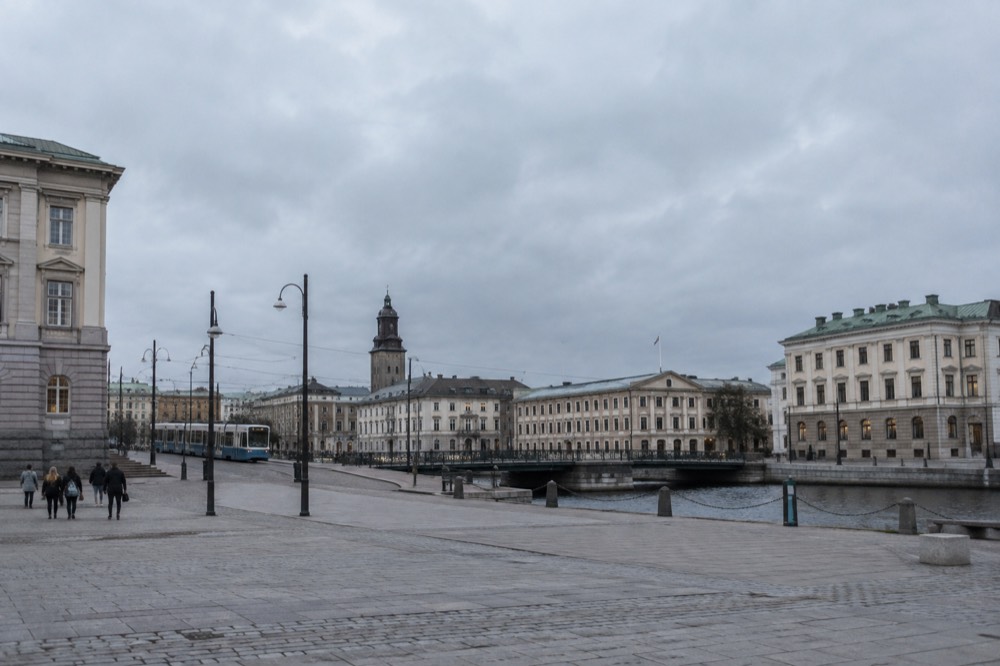
That symmetry is the corridor's quiet advantage. In Gothenburg, you reach the station by tram, and the tram network is the city's backbone: Göteborgs Spårvägar's own reporting describes twelve lines covering 134 stops and 188 kilometres of single track, from Mölndal in the south to Angered in the north and Saltholmen in the west, and the operator's site at goteborgssparvagar.se publishes the current journey figures. In Stockholm, the arrival platform connects straight down into the metro system. Door to door, the train journey therefore competes well against flying, because both airports sit well outside their cities and both central stations sit right inside them.
It is worth contrasting this with the other rail question travellers ask about Gothenburg: there is no train to Landvetter Airport at all. Swedavia's own transport pages for Landvetter list only coach and bus options, with the Vy flygbussarna airport coach taking 20 minutes between the terminal and central Gothenburg, a figure Swedavia states plainly on its airport bus page. The city's rail connections run between cities, not out to its airport, which is a fact that catches out visitors who assume a second city of this size must have an airport rail link. For more on that, see our piece on getting from Landvetter Airport into Gothenburg.
Is the Train Ride from Gothenburg to Stockholm Scenic?
The route crosses the Swedish interior, running along the west coast main line through farmland, lakes and pine forest rather than along the coast itself, so the scenery is pleasant and green rather than dramatic, with the most interesting stretches coming in the first hour out of Gothenburg and the approach into Stockholm. It is a comfortable ride, not a sightseeing one.
The line leaves Gothenburg heading north-east and spends most of the journey inside the flat to gently rolling country of Västergötland and Södermanland. Lake Vänern, Sweden's largest lake, sits west of the rail corridor, and the train skirts its region without running along its shore. What you see from the window for most of the trip is the classic Swedish interior: fields, birch, lakes glimpsed between trees, and small towns where the train may pause for a minute. Travellers who want the water-heavy view sometimes compare this corridor with the west coast runs towards Oslo, which is a different question we cover separately in is the Gothenburg to Stockholm train scenic.
Season changes the picture more than you might expect. In summer the interior is at its greenest and the long evening light means you see the whole landscape rather than a dark window; SMHI's daylight data for Gothenburg shows 18 hours and 6 minutes of daylight at the summer solstice against 6 hours 32 minutes at the winter solstice, and Stockholm runs similar numbers. A December departure means the window shows mostly night for the first and last stretch of the ride. In late winter, snow cover flattens the fields into white and the lakes into ice, which has its own quiet appeal but is a different journey from the June one.
If scenery is the priority, the honest framing is this: you take this train because it is the efficient way between Sweden's two largest cities, and the landscape is a pleasant backdrop, not the reason for the trip. The dramatic Swedish scenery, the Bohuslän granite coast, the archipelago, the lake country around Vänern, sits off this line, reachable by other routes and day trips. For the coastal alternative, our guide to where you can go by train from Gothenburg covers the lines that actually run along water.
Is the Train Better Than Flying from Gothenburg to Stockholm?
Door to door, the train is competitive with flying on this corridor and usually faster overall, because both Landvetter and Stockholm Arlanda sit well outside their cities, the airport transfer time on each end adds an hour or more, and the train runs city centre to city centre, so the rail option wins on total travel time for most itineraries and wins outright on carbon and comfort.
The arithmetic is the thing. A flight from Landvetter to Arlanda spends little time in the air, but the journey to Landvetter by Vy flygbussarna coach takes 20 minutes from central Gothenburg before check-in and security, and the Arlanda Express or coach into Stockholm adds a similar block on the far end. The train's station-to-station time, by contrast, includes no check-in, no security queue and no transfer at either end, and both stations sit on top of their cities' metro and tram networks. For a centre-to-centre trip, the rail total is the shorter one for most realistic schedules.
There is a second argument that has nothing to do with speed. The train carries you through the country you came to see, lets you work or eat at a table seat, and deposits you in central Stockholm within walking distance of the old town. The flight carries you over all of it at altitude and lands you a ride away from anywhere useful. Travellers planning Sweden's two-city itinerary consistently find that the train day feels like part of the holiday and the flight day feels like admin: on the train you can read, sleep, spread out at a table, and watch Sweden go by, while the flight day is a sequence of queues. For how to split your time once you arrive, our answer to how many days in Gothenburg is enough is the companion piece.
What Should You Know Before Booking the Gothenburg to Stockholm Train?
Book in advance for the cheapest fares, because Swedish long-distance pricing rises as departure fills, check whether your itinerary is direct or requires a change, and arrive at Göteborg Centralstation with time to cross to the long-distance platforms, since the northbound trains leave from the far side of the station. Tickets are sold per departure with an assigned seat, and the operator's own booking page is the source for current prices.
A few practical points, reported from the operator's published information and the station's own guidance:
| Question | What to do | Why |
|---|---|---|
| When to book | As early as your dates are fixed | Fares on this corridor are demand-priced and climb toward departure |
| Direct or connecting | Check the itinerary detail before paying | A change adds transfer time the headline price does not show |
| Which station | Göteborg Centralstation, both ends central | No out-of-town transfer needed at either end |
| Seat choice | Pick a table seat if working, a window if sightseeing | The booking flow shows the carriage layout before payment |
| Arrival buffer | Ten to fifteen minutes | Northbound platforms sit across the tracks from the main hall |
| Food and drink | A bistro car runs on most express departures | Check the service listing for your specific train before relying on it |
One more note for travellers starting in Gothenburg rather than ending there: the city rewards an extra half day before you leave. The southern archipelago is reached by tram and ferry from Saltholmen on an ordinary Västtrafik ticket, and Västtrafik's own zone information, published at vasttrafik.se, states that one Zone A ticket carries you from the centre all the way out onto the islands, which makes it the cheapest big excursion in the city. Our article on whether the Gothenburg archipelago is worth visiting covers what you get for that ticket.
And if the return leg leaves you a final morning in Gothenburg, the sightseeing options cluster near the stations and the canal, so a morning ride on the amphibious bus or a short canal cruise fits neatly before a midday departure north. The essential planning reference for the whole city is Gothenburg Travel Guide, which carries the current Liseberg season dates, transport fares and neighbourhood guides.
Common Questions About the Gothenburg to Stockholm Train
How long is the train ride from Gothenburg to Stockholm?
The fastest direct trains take roughly three hours, while stopping services and connecting itineraries take longer. The exact time varies by departure, so read the journey time shown for your specific train in the operator's timetable rather than relying on a single quoted figure.
Is there a high-speed train from Gothenburg to Stockholm?
The corridor is served by the fastest trains in the Swedish fleet, running on conventional main-line track rather than dedicated high-speed rail. We cover the details, including what "high speed" does and does not mean on this route, in our dedicated answer on the high-speed question.
Is the train ride from Gothenburg to Stockholm scenic?
Pleasant rather than dramatic. The line crosses farmland, lakes and pine forest through the Swedish interior. It is a comfortable working ride, not a sightseeing line; the coastal and lake scenery sits on other routes out of Gothenburg.
Where does the train leave from in Gothenburg?
Göteborg Centralstation, at the head of the canal in central Gothenburg, reachable by tram from anywhere in the city. Northbound long-distance trains depart from the platforms across the tracks from the main hall, so allow a few minutes for the crossing.
Is the train better than flying between Gothenburg and Stockholm?
For most centre-to-centre trips, yes. Both airports sit well outside their cities and add transfer time at each end, while the train runs central station to central station, so the total door-to-door time usually favours the rail option.
Should you book Gothenburg to Stockholm train tickets in advance?
Yes, if your dates are fixed. Fares on the corridor are demand-priced and rise as a departure fills, and popular departures, Friday and Sunday afternoons especially, sell down to the least desirable seats late in the week.