Masthuggskyrkan and the Best City Viewpoints in Gothenburg, Sweden
Gothenburg's best views come from granite hills, a hilltop church and a fortress ruin, and most of them cost nothing but a tram ticket.
Short answer
The best free viewpoints in Gothenburg are Masthuggskyrkan on Hisingen's edge, Ramberget on Hisingen, and Skansen Kronan in the old town's fortifications, all reached by tram or a short walk.
Gothenburg is a city built at the mouth of a river, and that geography is the whole reason its viewpoints are so good. The Göta älv splits the city in two, Hisingen rises on the north bank, and the old town sits inside its Dutch-engineered moat on the south side. From the right granite outcrop you can see shipyard cranes, the Älvsborg Bridge, the archipelago ferries heading out to sea, and a low ribbon of red rooftops running down to the water. Göteborgs Stad's own figures put the city at 613,274 residents at the end of 2025, and from Masthuggskyrkan's terrace nearly all of them appear to be below you.
This guide covers the viewpoints worth the walk, the ones locals actually use, and the honest logistics: which tram, which ticket, and what the light is doing when you get there. It also covers the ones that pair well with a swim, a museum or a boat, because a viewpoint in this city is rarely a destination on its own.
Why Does Masthuggskyrkan Have the Best View in Gothenburg?
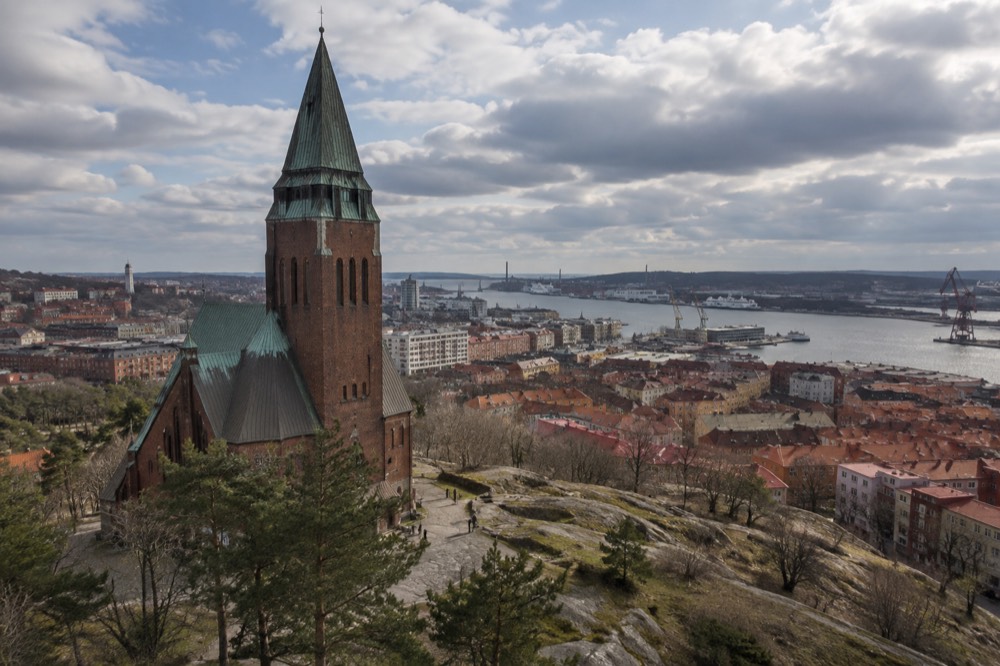
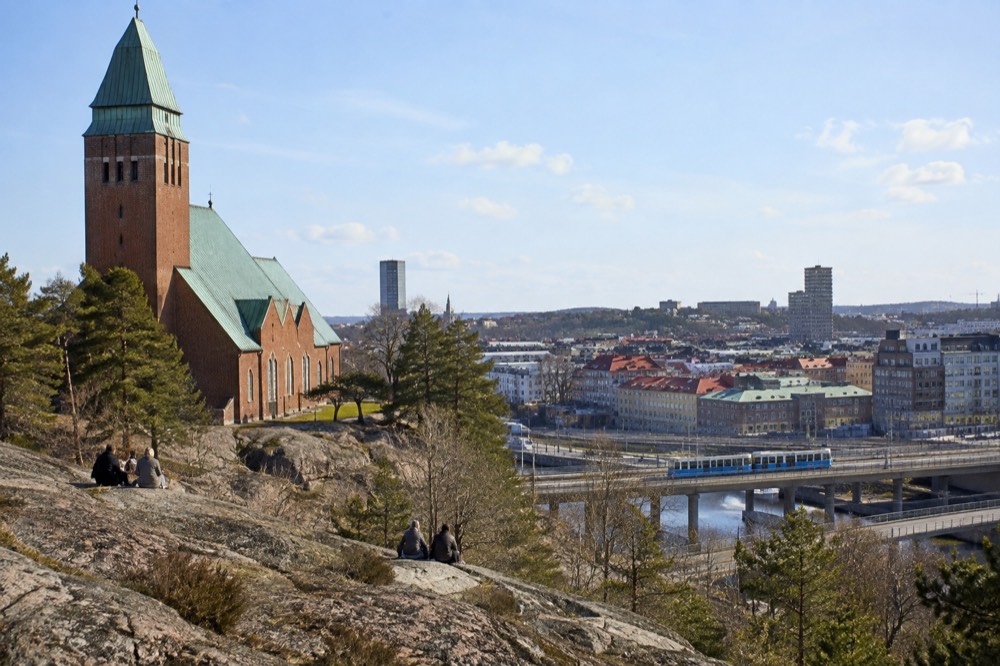
Masthuggskyrkan stands on a ridge above the Masthugget district on the south bank of the Göta älv, and its terrace looks straight across the river at Hisingen's shipyards, down the harbour channel toward the archipelago, and back over the rooftops of the old town, all from a single spot that costs nothing to stand on and is a short walk or one tram stop from Järntorget.
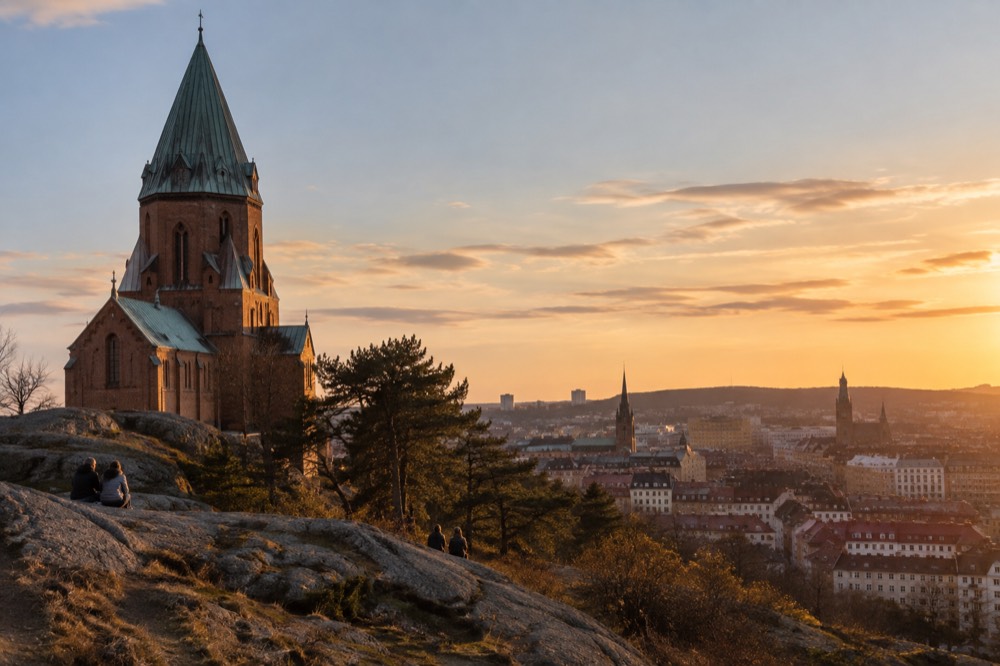
The church is a working Church of Sweden building, so the interior keeps ordinary congregation hours and the view is the free, always-available part. The terrace and steps around it face north and west, which is where the money is: the western harbour, the river mouth, and, on clear days, the faint line of the southern archipelago islands. Because the hill faces the water rather than away from it, the view works at noon and works even better at sunset, when the low western sea light hits the cranes and the Älvsborg Bridge.
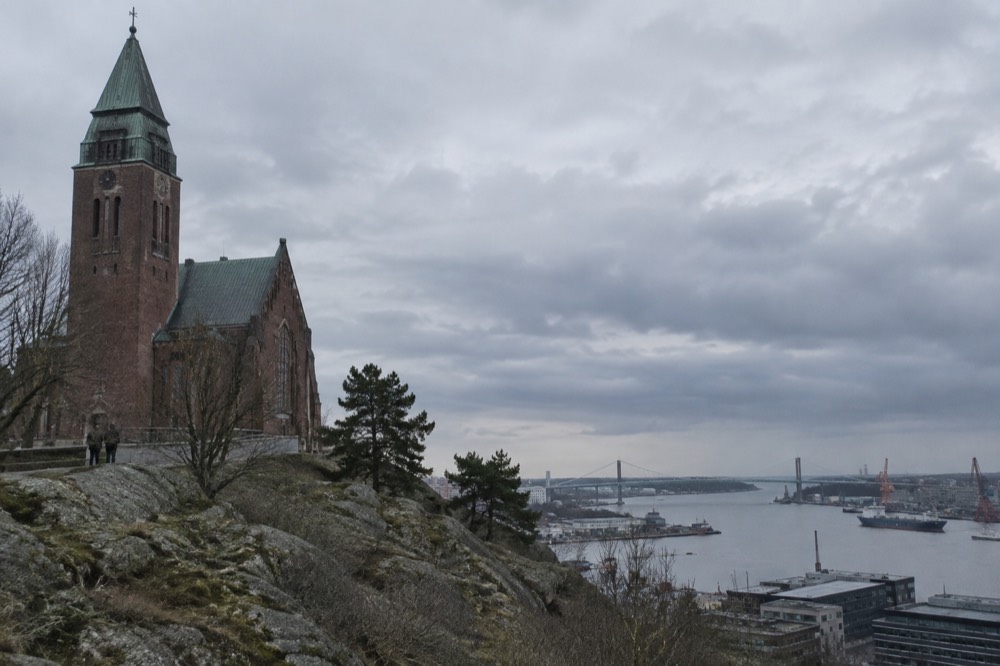
The district below the church, Masthugget, is one of the city's oldest working-class quarters, and the climb up from it is short but real. Come up from Järntorget on the west side or from Stigbergstorget, and you get the church, the terrace and the panorama in under fifteen minutes of walking from either. The streets on the way up are worth the trip on their own: painted wooden houses, corner shops, and the steep cobbles that give the district its character. For the full picture of how the tram system gets you to Järntorget in the first place, read getting around Gothenburg by tram.
One honest note on the weather: SMHI's 1991-2020 normals for station Göteborg A record 912 mm of precipitation across 127.3 days a year, and the wettest month is October at 102.9 mm, as published on SMHI's normals data page. The view is not going anywhere, but the visibility might, so check the sky before you commit to a sunset trip. April is statistically the driest month of the year at 51.3 mm, which makes spring the most reliable season for a clear panorama. It rains on roughly one day in three here, not the permanent drizzle of the guidebook reputation, and SMHI's own national summary does not identify Gothenburg as Sweden's rainiest place; the maxima sit in the western highlands and the mountains.
What Are the Best Viewpoints in Gothenburg, Sweden?
The five viewpoints worth planning around are Masthuggskyrkan for the harbour panorama, Ramberget on Hisingen for the classic skyline shot, Skansen Kronan for the old town and rooftops, the Slottsskogen ridge for a green, free-to-enter alternative, and the Älvsborg Bridge and Röda Sten waterfront for a river-level view, and every one of them is free to visit and reachable on an ordinary Västtrafik ticket.
Gothenburg is unusual in that its best views are almost all public land. There is no observation deck with a turnstile, no paid tower, no timed entry slot. The city grew around granite hills and left them alone, and the tram network, 12 lines and 188 km of single track as of Göteborgs Spårvägar's 2022 annual report, threads close to nearly all of them. That combination, free hills plus dense trams, is what makes a three-viewpoint afternoon realistic here in a way it is not in flatter or more privatised cities.
Here is how the main viewpoints compare:
| Viewpoint | What you see | Effort | Cost |
|---|---|---|---|
| Masthuggskyrkan | Harbour, Hisingen shipyards, river mouth, archipelago horizon | Short climb from Järntorget | Free |
| Ramberget | Full skyline, both banks of the Göta älv | Steep but short walk from Ramberget tram stop | Free |
| Skansen Kronan | Old town rooftops, moat, cathedral spire | Steps up from Haga | Free |
| Slottsskogen ridge | Green parkland, city to the north | Gentle paths | Free |
| Röda Sten / Älvsborg Bridge | The bridge, river traffic, Hisingen waterfront | Flat riverside walk | Free |
Ramberget deserves its own mention because it is the one locals send visitors to. It sits on Hisingen, the north-bank half of the city, and the hill is a nature reserve with the skyline laid out in front of it. The dedicated guide to Ramberget, the skyline view locals use, covers its paths and tram stops in detail. Skansen Kronan, the hilltop fort above Haga, trades width for intimacy: you look down into the old town's grid and the moat that Dutch engineers drew around it in the seventeenth century. Slottsskogen is the lazy option, a huge free park on the western ridge where the view arrives as a by-product of a walk rather than as the goal, and where the free zoo makes it a family favourite covered in Gothenburg with kids.
How Do You Get to Each Viewpoint by Tram?
Every major Gothenburg viewpoint is inside Västtrafik Zone A, where a single adult ticket costs 38 kr and a 24-hour ticket costs 125 kr, and the same ticket covers trams and buses, so reaching Masthuggskyrkan, Ramberget or Skansen Kronan is a matter of one or two tram rides from the city centre with no extra fare of any kind.
The tram is the honest answer to almost every "how do I get there" question in this city. Saltholmen, the archipelago ferry terminal, is itself the western terminus of the network, and Göteborgs Spårvägar recorded 126 million journeys in 2025, per the operator's own figures at goteborgssparvagar.se, which tells you how central the trams are to daily life here. The network runs from Mölndal in the south to Angered in the north, and from Saltholmen in the west to Kålltorp in the east, with the bridge to Hisingen carrying lines to the viewpoints on the north bank.
| Viewpoint | Nearest tram stop or route | Walk from the stop |
|---|---|---|
| Masthuggskyrkan | Järntorget or Masthuggstorget | 5-10 minutes uphill |
| Ramberget | Ramberget (Hisingen lines) | 5-10 minutes on park paths |
| Skansen Kronan | Haga Kyrkogata or Hagakyrkan | 5 minutes up the fort steps |
| Slottsskogen | Botaniska Trädgården or Linnéplatsen | 5 minutes into the park |
| Röda Sten | Västra Eriksberg or Lindholmen side | 10 minutes along the waterfront |
Buy tickets in the Västtrafik To Go app before boarding; you do not tap out on Gothenburg trams, a single bought ticket covers the ride. The fare details live on Västtrafik's ticket pages. One thing not to confuse: a temporary state subsidy currently halves 30-day period tickets, Zone A adult 890 kr down to 445 kr, but it does not touch the 24-hour and 72-hour tickets visitors actually buy. Your 125 kr day ticket is full price, and the discount is aimed at residents, not tourists.
If you would rather have someone else handle the routing on day one, the land-and-water amphibious bus tour drives the city streets and then launches into the harbour, which gives you the reverse of the Masthuggskyrkan view: looking up at the hills from the water. The operator's live listing carries current prices and departure times, and the tour runs about an hour, which makes it a warm-up rather than a whole day.
The amphibious tour earns its place on a viewpoint itinerary for one specific reason: it shows you the geometry. Seeing Masthuggskyrkan's ridge from the water, with the church sitting on top of its hill, explains why the terrace view looks the way it does, and it does so in an hour without a single climb. It is also the only tour in the roster that covers both the street-level and harbour-level perspectives in one sitting. Everything else covered here is indexed on Gothenburg Travel Guide.
When Is the Best Time of Day for Views Over Gothenburg?
Gothenburg's light is extreme by most visitors' standards: 21 June gives 18 hours 6 minutes of daylight with civil twilight from 02:58 to 23:30, while 21 December gives just 6 hours 32 minutes between sunrise at 08:54 and sunset at 15:26, so summer evenings offer endless golden hour and winter afternoons demand you be in position by 14:00.
The US Naval Observatory tables for Gothenburg's latitude of 57.7 degrees north make the swing concrete: 11 hours 34 minutes of daylight difference between the two solstices. In practice this means a June visit gives you a sunset panorama at 22:17 with the sky never fully dark, and a December visit gives you a low, slanting grey-gold light that photographers actually prize, if you catch it before the day ends in mid-afternoon. The full month-by-month light breakdown lives in daylight and darkness in Gothenburg.
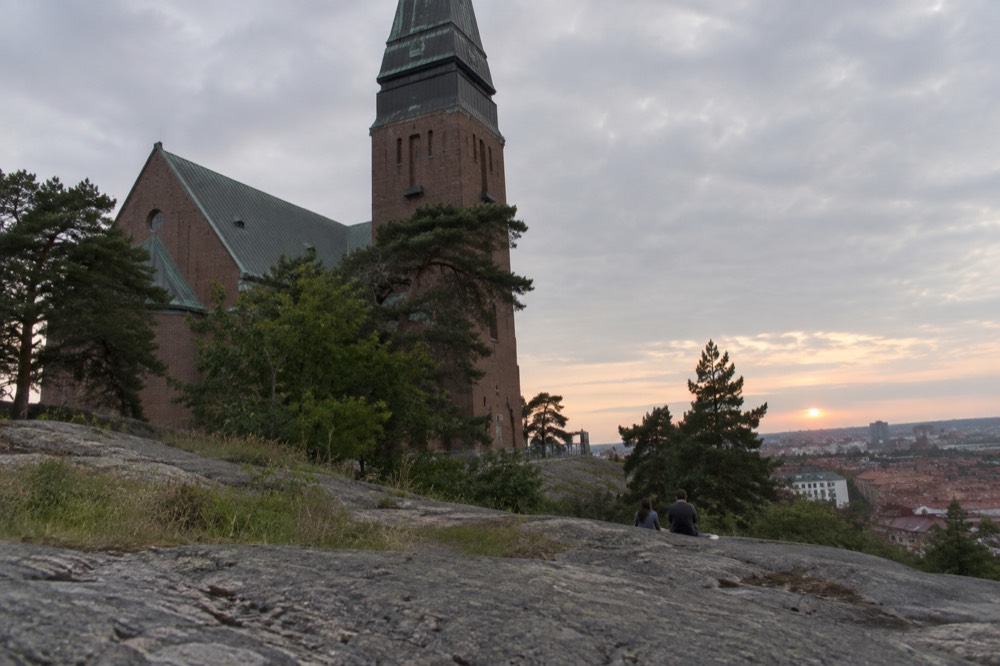
For Masthuggskyrkan specifically, the terrace faces west over open water, so it is a sunset spot. For Ramberget, the skyline faces south across the river, so it works all day. Skansen Kronan looks east and south into the old town, which makes it a morning-to-midday viewpoint when the sun lights the rooftops instead of silhouetting them. The seasonal summary lives in the best time to visit Gothenburg, alongside the sea-temperature data, which matters more than you would think: SMHI's Vinga station records show the sea peaks at 18.6 C in August, not July, and September water at 16.7 C is warmer than June water at 16.2 C.
Which Viewpoint Should You Choose for Photos of Gothenburg?
For the single classic Gothenburg photo, Ramberget on Hisingen is the answer, because its hilltop paths frame the whole skyline across the Göta älv with the river in the foreground; for the harbour and archipelago horizon, use Masthuggskyrkan; for rooftops and church spires at close range, use Skansen Kronan above Haga.
Each hill has a different job. Ramberget gives you the postcard: city, river, bridges, all in one frame, with pine trees in the near field. Masthuggskyrkan gives you industry and sea together, cranes and ferries and the Älvsborg Bridge, which is the more truthful picture of what Gothenburg is. Skansen Kronan gives you texture: the seventeenth-century street grid, copper spires, the green moat. The full photo-spot round-up, including lower-level angles along the canals, is in the best photo spots in Gothenburg.
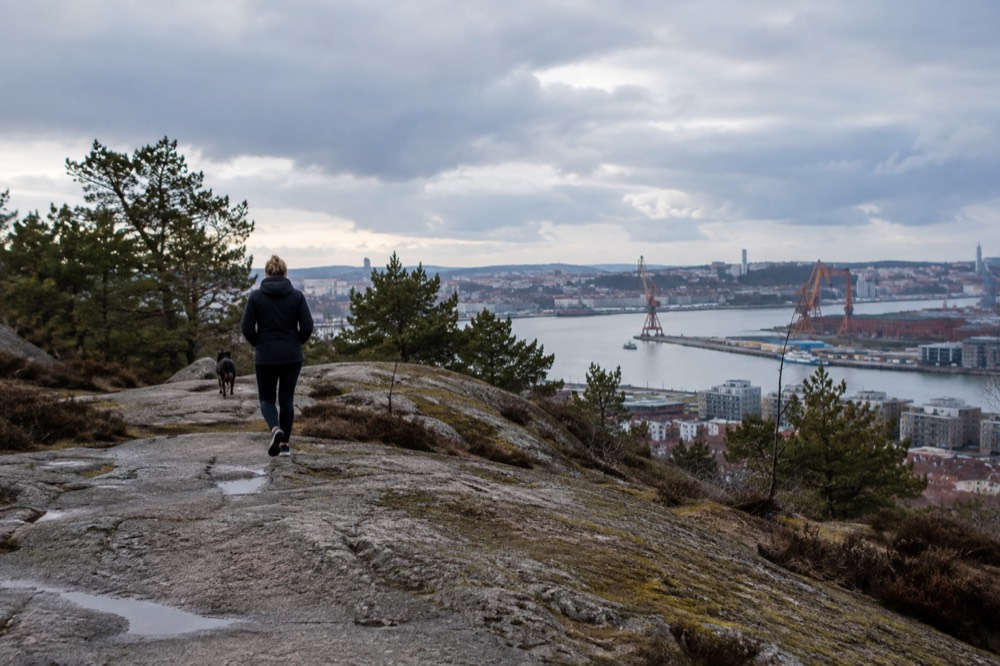
The season changes which hill wins. In the short winter days the low sun barely clears the rooftops, and Skansen Kronan's east-facing angle over the old town catches that light best. In June the problem is the opposite: the sun sets so late and so far north that Masthuggskyrkan's western terrace keeps working until nearly midnight. This is how the viewpoints sort out across the year:
| Season | Best viewpoint | Why |
|---|---|---|
| Spring (Mar-May) | Ramberget | April is the driest month of the year at 51.3 mm, the most reliable clear skies |
| Summer (Jun-Aug) | Masthuggskyrkan | Sunset at 22:17, terrace faces the western water, sea light on the cranes |
| Autumn (Sep-Nov) | Skansen Kronan | Low slanting light on the old town rooftops; October is the wettest month, so keep it close to shelter |
| Winter (Dec-Feb) | Ramberget or Skansen Kronan | Daylight only 6 h 32 m at the solstice, so pick the nearest hill and go at midday |
If you want the water-level version of the skyline, the 50-minute canal sightseeing cruise runs through the old moat and out into the harbour, passing directly below Masthuggskyrkan's hill. The listing shows a 4.7 rating from 783 reviews, and the operator's live listing has current departure times. It is the efficient way to see the viewpoints from the opposite direction without walking between them, and the moat section gives you a view of Skansen Kronan's ramparts that no hilltop can.
Can You Combine the Viewpoints with the Archipelago?
Yes, and it is the best-value day out in the city: a 125 kr 24-hour Zone A ticket covers the tram to Saltholmen and the archipelago ferries to Asperö, Brännö, Styrsö, Donsö, Vrångö and Köpstadsö, because the islands are part of Gothenburg's own Västtrafik network, and Vrångö's and Brännö's open meadows give sea-level views back toward the city.
The southern archipelago is not a day trip, it is a district of Gothenburg, and the car-free islands are reached on the same ticket you used for the tram. Västtrafik's own zone map shows the ferry lines numbered alongside trams and buses, and Göteborgs Stad's study of the southern archipelago states the islands are protected from private car traffic, with only taxi, färdtjänst and emergency services on the roads. That car-free status is exactly why the island viewpoints feel like open sea rather than suburb.
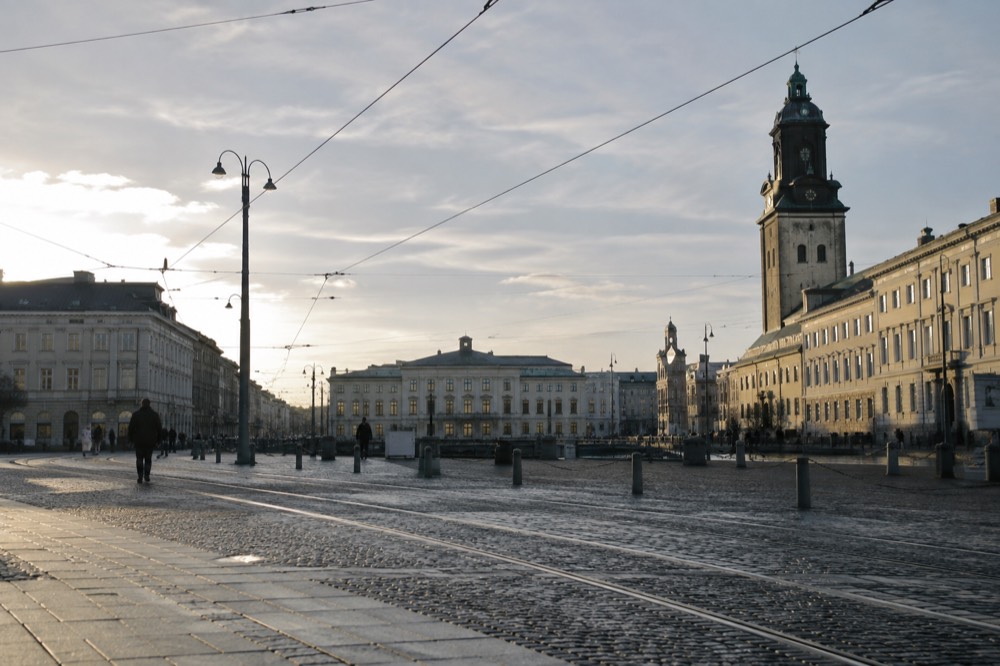
A realistic combined day: morning at Masthuggskyrkan, tram to Saltholmen, ferry to Brännö or Vrångö for the swim and the flat rocks, ferry back in the late afternoon, then Ramberget for the sunset skyline. The details of each island and ferry route are in the Gothenburg archipelago guide and how to get to the Gothenburg archipelago. If you would rather have a boat with a guide and commentary on the way out, the guided archipelago cruise runs 2.5 hours from the city centre with a 4.4 rating from 1,488 reviews on the operator's listing.
What Should You Know Before Climbing Gothenburg's Hills?
Wear real shoes, bring a windproof layer even in July, check whether the church interior is open if that matters to you, and plan around the season: the hills are short but the granite is polished smooth by ice-age glaciation, the harbour wind is constant at Masthuggskyrkan, and in winter the 15:26 sunset means the whole viewpoint circuit compresses into the middle of the day.
The practicalities are few but real. The granite outcrops at Ramberget and the island meadows are exposed, and the sea wind off the Kattegat does not respect summer calendar pages. SMHI's normals put July's mean air temperature at 18.3 C and January's at 0.8 C, but wind chill on an exposed hilltop runs several degrees below the street-level figure. None of the viewpoints has a café at the top, so carry what you need, and treat the climb as part of the experience rather than an obstacle to be minimised.
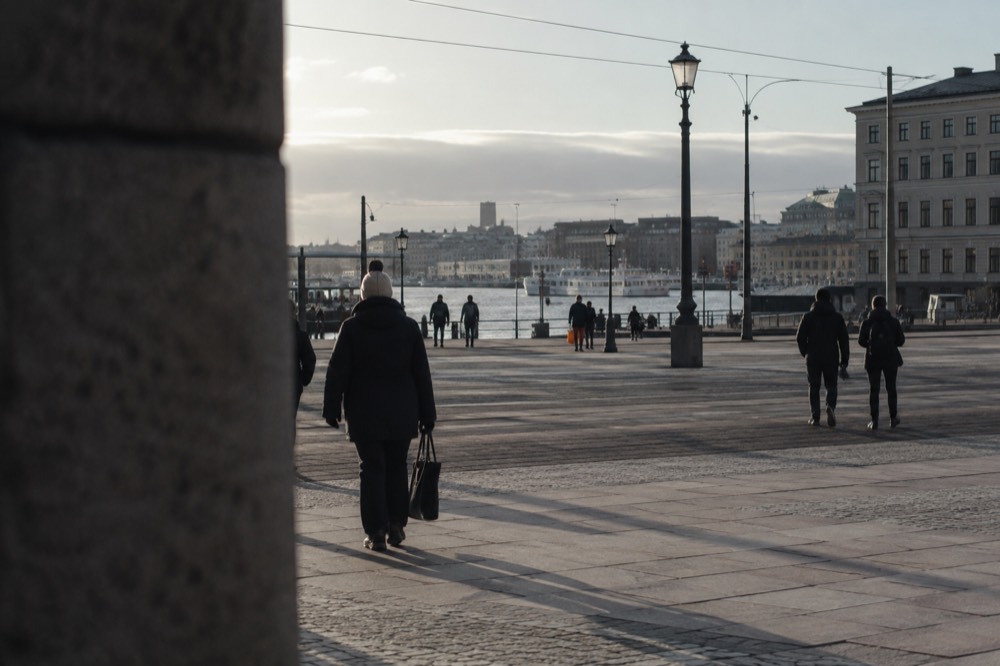
If the day turns wet, and on 127 days a year some rain falls, the indoor fallbacks are close: Gothenburg's museums cluster near several of the hills, and Göteborgs konstmuseum on Götaplatsen, with around 250,000 visitors a year and free entry for anyone under 20, is a short tram ride from most viewpoints. Note its own published plan: the museum closes in 2028 and reopens in 2032 for a rebuild, so a visit in the next two years is a visit during the building's final stretch before closure. For a fuller rainy-day plan, see Gothenburg on a rainy day, and for what the whole outing costs, is Gothenburg expensive has the numbers.
The viewpoints are the reason this city photographs better than its reputation suggests. Gothenburg Travel Guide exists to keep the practical details honest: which tram, which ticket, which hill, and what the sky is statistically likely to do while you stand on it. Pick one hill for the evening, save the archipelago for a full day, and the geography will do the rest.
Common Questions About Gothenburg Viewpoints
Is Masthuggskyrkan free to visit?
The terrace and grounds around Masthuggskyrkan are free and accessible at any time, and the view is from public ground. The church interior is a working Church of Sweden building and keeps congregation hours, so treat the interior as a bonus rather than the plan.
Which Gothenburg viewpoint is best at sunset?
Masthuggskyrkan faces west over the harbour and river mouth, so it is the sunset spot. Ramberget faces the skyline across the river and works at any hour. In June, sunset is at 22:17 local time, so plan a late evening.
Can you see the Gothenburg archipelago from the viewpoints?
On clear days the horizon from Masthuggskyrkan and the western harbour includes the line of the southern archipelago islands. For real island views, take the ferry from Saltholmen, which is covered by the same Zone A ticket as the tram.
How much does it cost to reach the viewpoints by tram?
A single adult ticket in Zone A costs 38 kr and a 24-hour ticket costs 125 kr, per Västtrafik's published fares. All the major viewpoints are inside Zone A, and the archipelago ferries are covered by the same ticket.
Is Ramberget or Masthuggskyrkan the better view?
Ramberget gives the classic full-skyline panorama across the Göta älv. Masthuggskyrkan gives the harbour, shipyards and river mouth. If you photograph one thing, go to Ramberget; if you want to understand what the city does, go to Masthuggskyrkan.
Are the viewpoints open in winter in Gothenburg?
Yes, all the main viewpoints are public outdoor spaces with no opening hours or gates. In December the sun sets at 15:26, so plan to be in position by early afternoon; the low winter light on the rooftops is a genuinely good photographic trade for the cold.