Where Can You Find the Best Fika in Gothenburg? Sweden's Coffee Ritual, Mapped
Where to find the best fika in Gothenburg, Sweden: Haga's giant cinnamon buns, the city's food halls, archipelago cafés, and how the Swedish coffee ritual actually works.
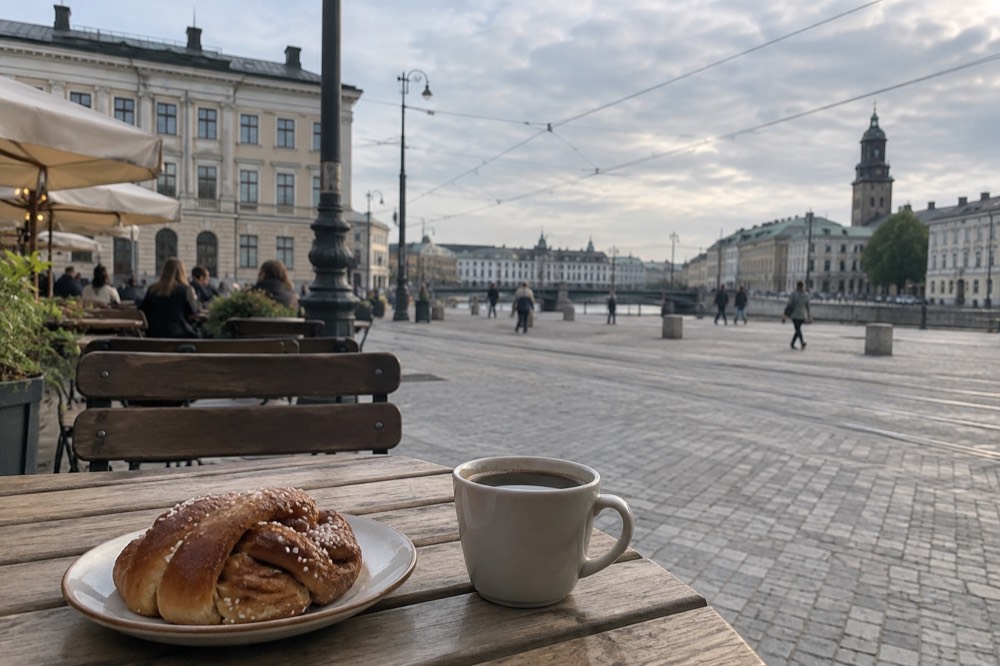
Fika is the closest thing Sweden has to a national pause button, and Gothenburg does it with more variety than almost any city in the country. It is not a coffee break. It is a fixed social habit with its own grammar: you stop, you sit down, you have something sweet with the coffee, and you do it in company. The cinnamon bun, the kanelbulle, is its centrepiece, and in Gothenburg that means one neighbourhood above all others.
The honest answer to "where is the best fika in Gothenburg" is that there is no single winner, because fika is a habit rather than a destination. What the city offers instead is a set of distinct fika scenes: the giant cinnamon buns of Haga, the food halls of the centre, the museum cafés of Avenyn, and the island cafés of the southern archipelago, each with a different rhythm. This page from Gothenburg Travel Guide maps them all, explains what to order, and tells you what fika actually is before you order it wrong.
What Is Fika, Really, Before You Go Looking for It in Gothenburg?
Fika is a scheduled social coffee stop, not a takeaway habit: you sit down, usually with other people, drink coffee or tea, and eat something sweet, most often a cinnamon bun. The word works as both noun and verb, Swedes say they "fika", and treating it as just Swedish for coffee is the single most common mistake English-language guides make. It happens mid-morning and mid-afternoon, and it is as much the pause and the company as the cup.
That grammar matters for your search, because it changes what "best" means. A place that serves excellent coffee but shuffles you out the door with a paper cup is not a fika spot, however good the beans. A fika place has seats, time, and a pastry counter. The ritual is protected enough in Swedish working life that many workplaces build two fika breaks into the day, and the habit survived the pandemic and the coffee-to-go era precisely because the sitting is the point.
There is a hierarchy to it, too. A fika with a colleague at the office canteen is the everyday version. A lördagsfika, the weekend version at home or in a café with family, is the fuller one, with more pastries and more time. And a fredagsfika, the Friday-morning workplace institution where the week's baker brings something homemade, is the one visitors never see but every Swede has opinions about. None of these are a coffee run. The cup is the excuse; the pause is the event.
If you want the full background on the word and the custom, our longer explainer covers what fika means in Sweden and, if you are worried about ordering it aloud, how to pronounce fika in Swedish. The short version for Gothenburg purposes: order a kanelbulle or a kardemummabulle (cardamom bun), take a seat, and do not rush.
One local nuance worth knowing before the bakery list: Gothenburg's fika culture leans plainer than Stockholm's. This is a working port city, and its baking tradition favours big, honest buns over delicate patisserie. That is exactly why Haga's famously oversized cinnamon buns became the fixture they are. The city's café scene grew up around shipyard workers and students, not around court pastry chefs, and the legacy is a counter culture where size and warmth beat decoration every time.
It also means the "best" fika is rarely the most polished one. The cafés locals defend hardest are the ones with mismatched furniture, a bakery smell that reaches the street, and a bun that was still warm at eleven in the morning. Gothenburg has plenty of beautiful third-wave coffee bars now, and they are good at what they do, but they are a different tradition. Fika predates the flat white in this city by generations.
Where Is the Best Fika in Gothenburg for a First-Time Visitor?
For a first-time visitor, Haga is the answer most locals and every guidebook will give you: it is the city's oldest working-class quarter, rebuilt in painted wooden houses, and its cafés are famous for hagabullen, a giant flat cinnamon bun served on a plate with a fork. The district is small, walkable in an hour, and the bun itself is a genuine local fixture rather than a tourist invention. No first fika in Gothenburg happens anywhere else with the same weight.
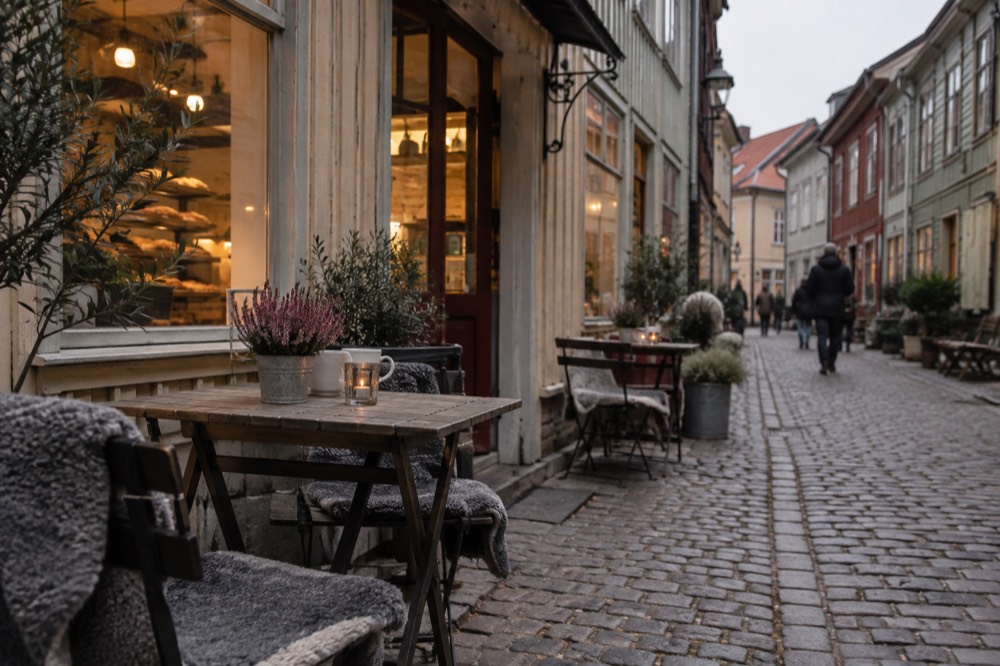
Haga's main drag, Nygatan and its network of cobbled side streets, has nearly every other doorway as a café. The buns here are the size of a small plate, dusted with pearl sugar, and priced as a sit-down pastry rather than a snack, because you are expected to take a table and work through it with a fork. On a weekend afternoon the queue for the best-known bakeries runs out the door, and locals will tell you the smart move is a weekday morning, when the same ovens produce the same buns for a fraction of the crowd.
The quarter deserves more than a coffee stop. It is one of the few parts of central Gothenburg that survived the modernist rebuilds of the postwar decades, and the wooden landshövdingehus buildings, timber upstairs and brick at street level because of old fire rules, are unique to this city. The type is so local that other Swedish cities barely have it: a law once required ground floors in wood buildings to be non-combustible, and Gothenburg's builders answered with brick bases and painted timber storeys above. Walking Haga is walking through that rule. Our full neighbourhood guide to what Haga is known for covers the rest of the quarter, including the hill up to Skansen Kronan if you want a view after your bun.
The climb is worth combining with the coffee. Skansen Kronan, the hilltop fort at the top of Haga's slopes, gives you the city's roofscape and the river mouth in one sweep, and the walk back down lands you directly in the café streets. A morning in Haga therefore organises itself: one hagabulle, one climb, one more bun on the way down, and no guilt, because you have earned the second one.
A guided walk is one honest shortcut here, because the fika stop comes with context. The trio above all build a proper Swedish fika into a Gothenburg outing: a two-hour city walking tour with a fika break, an archipelago cruise where the fika is served on the water, and an evening sail with the same idea. Each is run by an operator whose live listing carries the current price and availability.
Where Do Locals Actually Fika in Gothenburg, Away from Haga?
Locals fika where they live and work, which means Linnégatan and Vasastan west of the canal, Majorna's second-hand quarter further south, and the covered food halls in the centre. These areas have the everyday cafés Haga's fame has partly eclipsed: smaller buns, cheaper coffee, more cardamom than cinnamon, and tables full of people on laptops or with prams rather than suitcases. If you want fika as Gothenburg does it on a Tuesday, head to Linnégatan or Majorna.
Linnégatan is the strip locals treat as their living room in summer, and its café density is the highest outside Haga. Vasastan, just uphill, is the student quarter around Gothenburg's university buildings, and its cafés run on cardamom buns, big mugs, and long sits. Majorna, the old workers' district along the tram lines west, has the city's strongest second-hand-and-espresso pairing; the vintage shops and the coffee stops share the same streets, and an afternoon there alternates naturally between the two.
The covered markets are the other local answer. Saluhallen, the Victorian market hall, and Feskekôrka both do fika now, and Feskekôrka is a stranger story: the fish-church-shaped market hall from 1874 closed for renovation, then reopened in 2024 as a full food hall with two fish counters and five restaurants rather than only fishmongers. A coffee and a pastry inside a building that looks like a wooden church, next to a wet fish counter, is a very Gothenburg experience. Our Feskekôrka guide has the details, and the food guide covers the rest.
What Should You Order at Fika in Gothenburg?
Order a kanelbulle (cinnamon bun) or a kardemummabulle (cardamom bun), plus filter coffee or a kaffe latte, and in spring look for the seasonal semla, a cream-and-almond-paste bun traditionally eaten in the run-up to Lent. In Haga, order the giant hagabulle. Coffee refills are often included with filter coffee, and the pastry is not optional: fika without something sweet is just coffee.
The bun counter, so you know what you are pointing at:
| Swedish name | What it is | When Gothenburg eats it |
|---|---|---|
| Kanelbulle | Cinnamon bun with pearl sugar | Year-round, the default |
| Kardemummabulle | Cardamom bun, the local favourite | Year-round |
| Hagabulle | Giant flat cinnamon bun, served with a fork | In Haga, always |
| Semla | Cardamom bun filled with almond paste and whipped cream | Traditionally from Shrove Tuesday through Lent |
| Kladdkaka | Sticky chocolate cake | Year-round, the safe non-bun choice |
| Prinsesstårta | Layered cream cake with green marzipan | Celebrations and weekends |
One practical note on the coffee itself: Swedes drink filter coffee in volume, and a påtår, the refill, is often included at self-service counters. Ask and you will rarely be refused. Tea has caught up in the last decade, so non-coffee-drinkers are not stuck with nothing. Hot chocolate is the standard children's order, which is why a Swedish family fika works for every generation at the table.
And one rule that catches visitors: the sweet thing is not optional. Fika is the pairing, not the drink. Ordering a black coffee and standing at the counter is a coffee stop, and it is a different thing with a different name. The word for the pastry matters too: a bulle is a bun, and asking for "en bulle" in a Gothenburg bakery will get you a follow-up question, cinnamon or cardamom, because those are the two pillars of the local counter.
Can You Fika on the Gothenburg Archipelago?
Yes, and the islands are arguably the best fika setting in the city, because the southern archipelago is part of Gothenburg, not a day trip: the ferries from Saltholmen are covered by an ordinary Västtrafik ticket and the islands sit in Zone A, so a 125 kr 24-hour Zone A ticket covers the tram to the boat and the crossing. Several islands, including Styrsö and Brännö, have café traditions of their own, and the boats run year-round.
This is the city's best-value trick and most visitors never use it. You ride a tram west to Saltholmen, the western terminus of the tram network, board a Västtrafik ferry, and twenty minutes later you are fika-ing on a car-free island in the Kattegat. The islands of the southern archipelago, Asperö, Brännö, Styrsö, Donsö, Vrångö and Köpstadsö, are protected from private car traffic by city ordinance, so the walk from jetty to café is on gravel lanes and granite. Västtrafik's own zone pages confirm the arrangement: the islands are reached on a Zone A ticket, the same one that covers the trams.
Island fika is plainer and better for it: cinnamon buns and waffles in village cafés that open with the ferry timetable. Brännö in particular has a café culture that locals treat as a destination in itself. Time it with the sea, not the crowds: SMHI's archive from the Vinga lighthouse station shows the water peaks in August at 18.6 C, and September's sea (16.7 C) is warmer than June's (16.2 C), so a September island fika comes with warmer swimming than a June one. Our guide to whether the Gothenburg archipelago is worth visiting covers the practicalities.
If you would rather have the ritual explained than reverse-engineer it, the guided walking and fika tour above pairs a city walk with a proper sit-down fika, and the operator's listing carries the current price, times and availability.
When Is the Best Time of Day, and Year, for Fika in Gothenburg?
The best time of day is mid-morning, roughly 10:00 to 11:00, or mid-afternoon around 15:00, which are the two slots Swedish working life actually reserves for fika; weekend afternoons are when cafés are fullest. The best time of year is harder: October is statistically the wettest month in Gothenburg at 102.9 mm of rain, which is precisely fika weather, while April is the driest at 51.3 mm, which is when café terraces open.
The seasonal logic is real. SMHI's 1991-2020 normals for the Göteborg A station put annual rainfall at 912 mm across 127 days, about one day in three, and the wettest stretch arrives in October and November, after the summer visitors leave. A rainy city is a café city, and Gothenburg's fika scene is built for exactly that: small rooms, big buns, no hurry. Winter fika is its own genre, with the Christmas season adding saffron buns (lussekatter) and gingerbread to the counters.
Timing your fika around a walk is the pattern most visitors settle into: Haga in the morning, an island or a museum café in the afternoon. The rhythm works because the city is compact, the trams are frequent, and no two fika stops need be more than twenty minutes apart. Plan the day around the buns and the rest of Gothenburg arranges itself around you.
Common Questions About Fika in Gothenburg
Where can I find the best fika in Gothenburg?
Haga for a first visit, specifically for the giant hagabulle cinnamon buns; Linnégatan and Majorna for the cafés locals use; the southern archipelago islands for the setting. There is no single winner, because fika is a habit with a grammar, and the best version is the one with time to sit.
What is a hagabulle?
A giant, flat cinnamon bun served in Haga's cafés, big enough to need a plate and a fork. It is a genuine local fixture of the neighbourhood rather than a tourist invention, and it is the pastry most visitors photograph in Gothenburg.
Is fika just a coffee break?
No. Fika is a social institution: you sit down, drink coffee, eat something sweet, usually a cinnamon or cardamom bun, and do it in company, typically mid-morning or mid-afternoon. Treating it as merely Swedish for coffee is the most common mistake English-language guides make.
Can you fika on the Gothenburg islands?
Yes. The southern archipelago islands are part of the city, the ferries from Saltholmen take ordinary Västtrafik tickets, and islands such as Brännö and Styrsö have café traditions of their own. A 24-hour Zone A ticket covers the tram, the ferry and the islands.
What should you order at fika?
A kanelbulle (cinnamon bun) or kardemummabulle (cardamom bun) with filter coffee, which often includes a free refill, a påtår. In spring look for the semla, and in the Christmas season the saffron lussekatter. The pastry is not optional; fika is the pairing.
When do Swedes have fika?
Mid-morning and mid-afternoon are the traditional slots, and many Swedish workplaces still schedule both. Weekend afternoons are the busiest time in cafés, so a weekday morning gets you the same bun with a shorter queue.
The trio above is the full fika-with-a-guide spectrum: a city walk with a sit-down break, an archipelago cruise with fika served on board, and an evening sail with the same. Check availability on each operator's live listing for current times and prices, and then pick your bun.